The Hybrid Event Production Guide for Corporate Planners

Hybrid event production is one of the most misunderstood disciplines in corporate events - and that misunderstanding costs companies real money and real audiences. The moment you add remote viewers to a live event, you stop running one show. You are running two. The planners who treat that seriously from day one tend to produce events that land for everyone in the room and everyone watching from somewhere else.
At GlobeStream Media, every production decision starts with the same question: what does the audience need to feel engaged, informed, and inspired? That applies to the person in row three and the person watching on a laptop in a hotel room across the country. Both are your audience. Both deserve the same care. Our approach to hybrid event production is built on that principle - audience first, technology second, always.
Why Hybrid Event Production Is Not Just "Adding a Stream"
The most common planning mistake we see is treating the virtual component as an afterthought. The in-room show gets the full design treatment - lighting, staging, speaker prep - and then someone adds a camera feed for the remote audience. That approach almost always produces a poor experience for virtual attendees, and over time, it shows up in weaker engagement and lower participation.
Here is the reality: a remote audience cannot feel the energy in the room. They cannot pick up on body language or lean over to a colleague between sessions. What they experience is exactly what your production delivers - the quality of the video, the clarity of the audio, the timing of the graphics. When those elements are an afterthought, the virtual audience knows immediately. They feel like guests who were not really invited.
Research indicates that 76% of event organizers report growing appetite for the hybrid format, and 70% anticipate it becoming a permanent fixture in corporate event planning. The standard those audiences expect has gone up. Meeting it means designing intentionally for both rooms from the start.
Start with the Audience, Not the Equipment
The biggest planning mistake in hybrid event production is letting technology drive the decisions. Brett Casadonte, CEO of GlobeStream Media, puts it directly: "You really need to start with the message and start with your brand because whenever you create a live experience, it needs to be, first and foremost, an authentic representation of your brand."
That is an audience-first principle. Before you think about cameras, streaming infrastructure, or encoding systems, answer a more fundamental set of questions. Who is your audience - in the room and remote? What do you need them to feel? What do you want them to walk away knowing or doing? Those answers shape every production decision that follows - from how the stage is designed to how the virtual environment is built.
Budget alignment falls into the same category. As Mr. Casadonte notes: "The scope of productions can vary so dramatically and impact the cost of a production." Hybrid events carry costs that in-room shows do not - dedicated streaming infrastructure, additional operators, encoding hardware, and possibly virtual platform licensing. Planners who anchor to in-room budgets without accounting for those additions often find themselves making cuts late in the process, usually at the expense of the remote audience.
What Hybrid Event Production Actually Requires
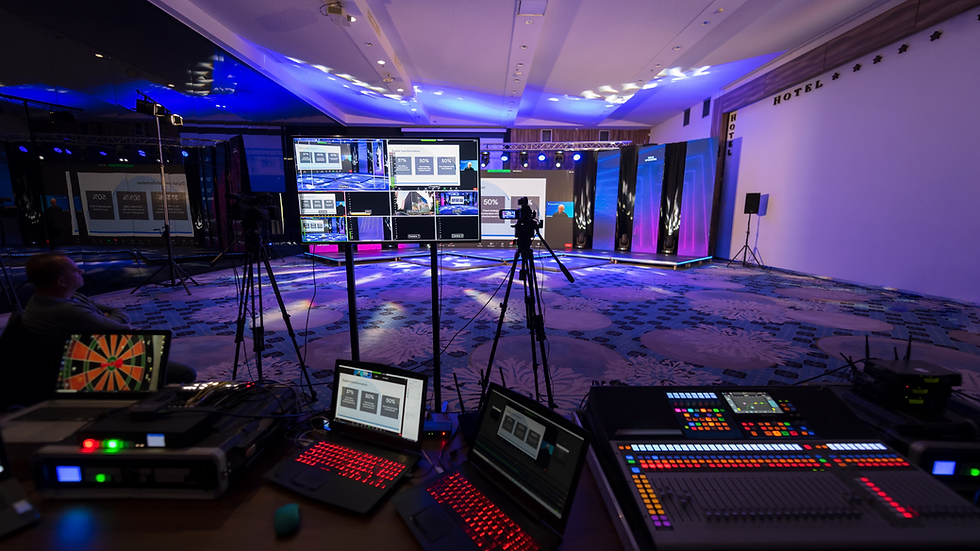
A traditional corporate AV setup is designed to serve the people sitting in the venue. In a hybrid production, that foundation is still there - but there is a parallel layer of infrastructure designed entirely for the remote audience: multi-camera capture to give virtual viewers broadcast-quality visuals, dedicated audio mixing for the stream, and encoding and transmission systems to deliver the signal reliably.
Staffing a hybrid event requires more than scaling up a standard crew. Beyond the core production team managing the in-room experience, a true hybrid production adds roles that exist solely to serve the remote audience. That typically means a dedicated technical director focused on switching the remote show feed, a streaming engineer managing encoding, transmission, and stream health in real time, and - when a dedicated virtual platform is in play - a platform administrator keeping the digital environment running smoothly for attendees on the other side of the screen. Each of those roles is a specialization, not an afterthought, and the quality of the remote experience depends on treating them that way.
PTZ cameras - also called robos or robotic cameras - are worth specific attention in a hybrid format. They are affordable to add, a single operator can manage multiple units at once, and they fit in places where traditional manned cameras cannot go. A PTZ at the front of the stage creates the upward-looking angle familiar from TED Talks; units hung from truss give the virtual audience overhead perspectives that add visual texture to the remote experience.
Why the Virtual Audience Deserves Its Own Design
Remote attendees judge your brand based on what they see and hear through the stream. If the video is choppy, the audio is muddy, or the feed drops mid-keynote, that is the event they experienced. They did not get to feel the room. The stream was everything. That is why the virtual layer needs its own dedicated design - not a simplified version of what is happening in the room, but a purpose-built experience for the people watching remotely.
At GlobeStream Media, the standard we hold hybrid productions to is straightforward: no attendee - in person or online - should feel like a second-class participant. That means interactivity matters too. Live Q&A, breakout rooms, and polling are baseline expectations for enterprise hybrid events. Virtual attendees who can ask questions and join conversations feel like participants; those who can only watch feel like viewers. That distinction shows up in engagement, and it shows up in how your audience remembers the event.
How Early Planning Shapes the Audience Experience
Hybrid event production has more moving parts than a standard in-room show - more crew, more equipment, and more coordination points that need to be tested and confirmed before the first attendee logs on. The single biggest advantage you can give both audiences is time. Build it into your timeline early. Run full technical rehearsals that include the streaming path, the virtual platform, and the remote presenter workflow. The productions that go smoothly are almost always the ones where the team had enough runway to find and fix problems before they became show-day emergencies.
Engaging your production partner early means the system is designed around your goals and your venue from the start, rather than adapted from a generic setup under deadline pressure. It creates space for rehearsals - which are not optional in a hybrid format - so that presenters, operators, and virtual hosts are fully comfortable before the first remote attendee logs on.
Working with an independent production partner rather than in-house venue AV also makes a meaningful difference. On average, independent partners are around 30 to 40% more cost effective than venue AV providers - which creates real room in the budget to invest in the elements that matter most for both audiences.
The Audience Is the Event
A well-executed hybrid event does not feel like a live show with a side stream attached. It feels like one experience delivered through two channels, built for the people receiving it. When you design with both audiences in mind from the start, in-room energy is amplified by a broader reach, remote attendees feel like genuine participants, and your message lands with everyone who needs to hear it - regardless of where they are sitting.
At GlobeStream Media, audience-first hybrid event production is the approach we bring to every corporate event we partner on. If you are planning a hybrid event and want a production team that designs for both audiences from day one, reach out to GlobeStream Media to start the conversation.
Frequently Asked Questions
What makes hybrid event production different from standard event AV? Standard event AV is designed to serve the people in the room. Hybrid event production adds a dedicated layer for remote attendees - multi-camera broadcast setups, separate audio mixing for the stream, encoding and transmission infrastructure, and additional operators managing the virtual experience in real time. They are fundamentally different disciplines, and treating them as one tends to shortchange at least one audience.
How far in advance should I start planning a hybrid event? The more complex the event, the earlier your production partner needs to be involved. For a large-scale hybrid event with multiple rooms and a global virtual audience, three to six months of lead time gives the team runway to design the right system, run rehearsals, and resolve technical details before anyone is watching. Smaller events may need less, but earlier is almost always better when two audiences are depending on the outcome.
Is hybrid event production significantly more expensive than an in-room show? Generally yes - and knowing why helps planners build an accurate budget from the start. A hybrid production adds dedicated streaming infrastructure, encoding systems, platform costs, and additional crew to manage the remote experience. Working with an independent production partner rather than in-house venue AV offsets a meaningful portion of those costs. On average, independent partners run around 30 to 40% more cost effective than venue AV providers - which creates room in the budget to put toward the production elements your remote audience will actually feel.
Summary
Hybrid event production requires designing two simultaneous experiences - one for the room, one for the remote audience - with equal intention. The most common failures happen when technology drives decisions before audience and brand goals are clear, or when the virtual experience is treated as secondary to what is happening in the room. An audience-first approach defines what both groups of people need to feel and take away, then builds the production infrastructure to deliver that. Engaging a production partner early, budgeting for the full scope, and rehearsing the hybrid system before show day are the practical steps that separate events that connect from ones that leave half the audience feeling like an afterthought.


Comments