Broadcast Services in Dallas: What Sets a Full-Service Team Apart

Broadcast services in Dallas cover a wider range of work than most planners expect, and that range is exactly where confusion tends to start. Is broadcast the same thing as a livestream? Is it the same as AV production? The short answer is no. Broadcast services bring a level of technical discipline, camera work, and production planning that goes beyond simply pointing equipment at a stage and turning it on.
Dallas has built one of the busiest corporate event markets in the country, with a convention infrastructure that reflects the scale of the businesses headquartered here. That scale raises the bar for what audiences expect to see when a company presents to them, whether the audience is in the room or watching from somewhere else entirely. Getting broadcast right takes more than good equipment. It takes a team that thinks in terms of a show, not a setup. As Brett Casadonte, our CEO, puts it, "The equipment that is used to do the really spectacular productions that you see is not inexpensive. It's not uncommon that we will do a corporate event where we are literally putting over a million dollars worth of equipment on site." That investment only pays off when it is guided by people who know how to use it.
What Are Broadcast Services and How Do They Differ From Standard AV
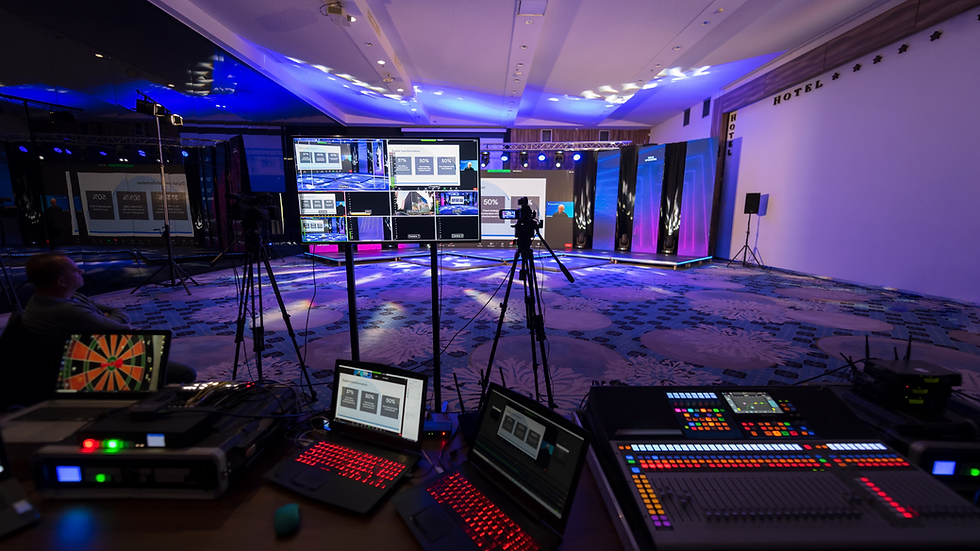
A standard AV company delivers equipment and operates it: microphones, speakers, a screen, maybe a single camera. Broadcast services go further, involving multi-camera coverage, live switching between angles, graphics, replay, audio mixing at a broadcast level, and a director making real-time decisions about what the audience sees and hears at every moment.
The distinction shows up clearly in how an event reads to the people watching. A single static camera on a stage feels like a recording of a meeting. A multi-camera broadcast, with a technical director cutting between wide shots, close-ups, and slide content, feels like something produced with intention. That difference is often what separates an event people tolerate from one they remember. Teams built around this discipline tend to describe it as bringing television production standards into the corporate world, thinking in editorial flow and audience experience rather than just camera angles and microphone placement.
What Should You Look For in a Dallas Broadcast Services Provider
A few questions separate a genuine broadcast partner from a vendor who simply uses the word loosely in their marketing.
Ask how many cameras a typical production includes and who is directing the switch between them. A single operator running one camera is not broadcast production, regardless of how the service is labeled. A true multi-camera setup usually starts at three to five synchronized cameras, giving a director enough coverage to build a dynamic picture rather than a flat one.
Ask whether the team builds a run of show and rehearses it. Broadcast-grade productions are planned like a show, with scripted transitions, cued graphics, and rehearsed timing, not improvised in the moment. That discipline is what prevents the awkward pauses and mismatched transitions that make a corporate broadcast feel amateur.
Ask about redundancy. Encoding failures, signal drops, and hardware issues happen, even with good equipment. A provider with backup encoders, redundant connectivity, and an experienced crew can recover from these moments without your audience ever noticing. A provider without that redundancy leaves your event exposed at the exact moment it counts.
Can One Company Handle Both the In-Room Production and the Broadcast for My Event
Yes, and this is one of the clearer advantages of working with a full-service partner rather than stitching together separate vendors for the room and the stream. When the same team manages both the in-person production and the broadcast or livestream, the two experiences get designed together from the start instead of pieced together at the last minute.
A lighting setup chosen purely for how a room looks in person can wash out or underexpose on camera if the broadcast team was never part of that decision. A stage layout built without camera sightlines in mind can force awkward angles that undercut the entire production. When AV and broadcast live under one roof, these tradeoffs get resolved during planning instead of discovered on event day. As Brett puts it, part of our job is to help bring an authentic representation of a client's brand to life, and that gets harder to do consistently when the in-room experience and the broadcast are handled by two teams that never talk to each other.
How Much Do Broadcast Services Cost for a Corporate Event
This is one of the most common questions we get, and the answer depends heavily on scope. As Brett explains, "The scope of productions can vary so dramatically and impact the cost of a production." A single-camera livestream of an internal town hall costs far less than a multi-camera broadcast with graphics, replay, and a directed program feed for a national sales kickoff.
The equipment alone can represent a real investment for high-end productions, and that cost reflects genuine capability: broadcast-grade cameras, switchers, encoders, and redundant systems that keep a show running even when something fails behind the scenes. The bigger cost driver, though, is usually crew. A broadcast production requires camera operators, a technical director, an audio engineer, and often a graphics operator, all working in coordination. Planners who understand this upfront can make more informed decisions about where to invest and where a simpler setup will serve their goals just as well.
Why Broadcast Quality Matters More for Dallas Corporate Events
Dallas is home to a dense concentration of Fortune 500 companies, and the audiences attending or watching corporate events here tend to have high expectations shaped by that business environment. A broadcast that looks unpolished reflects on the organization presenting it, whether that impression is fair or not.
This is especially true for events with a remote audience, since a livestream is often the only version of the event that people outside the room ever see. Reliable audio, clean camera work, and a well-paced program are not extras for those viewers. They are the entire experience. Treating the broadcast as a secondary consideration to the in-room event consistently produces a weaker result for a real share of your audience.
If you are planning a Dallas event that needs to look and feel as professional as the organization behind it, contact GlobeStream Media. We build the in-room production and the broadcast together, from the same team, so both audiences get the experience they deserve.
Frequently Asked Questions
What is the difference between a livestream and full broadcast services? A basic livestream often uses a single camera and minimal production value. Broadcast services involve multiple cameras, a director switching between them in real time, graphics, and professional audio mixing, resulting in a far more polished and engaging final product.
Do I need broadcast services if my event is only for an in-person audience? Broadcast-level production adds real value even without a remote audience. Multi-camera coverage and a directed video feed on large screens can dramatically improve how content lands for people seated farther from the stage.
How many cameras does a corporate broadcast typically need? It depends on the event, but most professional broadcast productions use at least three to five synchronized cameras. Larger or more complex events, such as multi-day conferences or product launches, often require more to capture every angle that matters.
The Bottom Line on Broadcast Services in Dallas
Broadcast services in Dallas go well beyond standard AV, bringing multi-camera coverage, real-time directing, and television-level production discipline to corporate events. The providers who deliver this well treat broadcast as its own craft, built around a run of show, backed by redundancy, and integrated with the in-room production rather than handled separately. For Dallas organizations presenting to audiences who expect polish, whether those audiences are in the room or watching remotely, that level of production quality is often what determines whether an event is simply attended or genuinely remembered.


Comments